GLFx Chapters Programme 2027: Join the GLF Global Network
Apply for the GLFx Chapters Programme 2027. Locally-led organisations in Africa, Asia-Pacific, and LatAm will gain seed funding, mentorship, and global reach.
FUNDOPPORTUNITIES
GLFx Chapters Programme 2027: Locally-Led Organisations Can Now Join the World's Largest Landscape Network
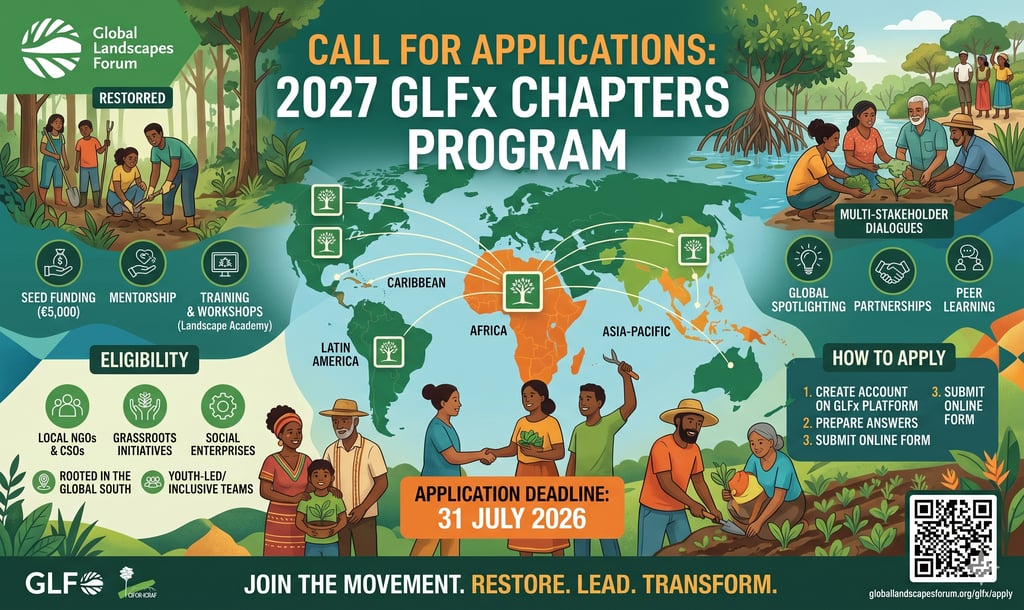
The Global Landscapes Forum (GLF) has opened its call for the GLFx Chapters Programme 2027, inviting locally-led civil society organisations across Africa, Asia-Pacific, Latin America, and the Caribbean to join one of the sector's most ambitious grassroots-to-global networks. Selected organisations gain access to seed funding, capacity development, strategic partnerships, and a platform that carries their work from community landscapes to international policy spaces.
This isn't a grant you apply for and forget. It's membership in an active, year-round network built on the principle that the communities closest to the land should be at the centre of decisions about it.
The application deadline is 31 July 2026, 23:59 CEST. Verify the current application status directly on the GLF website before submitting.
What GLFx Is, and Why It Matters
GLFx is GLF's decentralised, locally-rooted network of community-oriented organisations and grassroots initiatives. Chapter members span forest-dependent communities in the Congo Basin, agroforestry cooperatives in Central America, soil restoration collectives in South and Southeast Asia, and Indigenous-led conservation bodies across the Pacific. What connects them isn't geography; it's a shared commitment to transforming landscapes from within, rather than waiting for top-down policy to catch up.
Chapters don't just receive support. They shape the network. Through peer exchange, regional assemblies, and thematic hubs, GLFx chapters co-create knowledge, advocate for policy change, and bring localised evidence into global conversations at events like GLF Africa and COP side sessions. That's the model: local action with global amplification.
Since its founding, GLFx has hosted chapters working across reforestation, ecopreneurship, biodiversity recovery, sustainable livelihoods, soil health, and community land rights. Each brings a distinct context. All operate under the same values of inclusion, trust, and ecological integrity.
Who Can Apply
The GLFx Chapters Programme 2027 targets registered civil society organisations or groups with formal local accreditation. Eligible organisation types include NGOs, community-based organisations, research centres, and social enterprises. Individual applicants don't qualify; this is an institutional opportunity.
Beyond registration status, GLF looks for organisations that:
Work with, represent, and are made up of local communities in Africa, Asia-Pacific, Latin America, or the Caribbean
Are led by people from the geographic area where the organisation operates; not managed externally
Focus on landscape action tied to food security, regenerative livelihoods, biodiversity, climate resilience, sustainable land use, or social inclusion
Actively promote collaboration and partnership among landscape actors
Have a functional administrative structure capable of receiving and managing funds
The programme extends a specific invitation to organisations with a demonstrated track record in mobilising local actors, an intentional approach to involving youth, women, Indigenous Peoples, and communities in vulnerable conditions, existing stakeholder partnerships within the landscape, and diverse leadership that reflects inclusive governance.
That last cluster matters. GLF's commitment to localisation isn't performative. The organisations selected consistently reflect leadership structures that mirror the communities they serve.
What Being a GLFx Chapter Gives You
GLF structures support across five domains;
Action. Chapters access targeted seed funding calls, expert technical guidance, and direct connections with potential donors and fundraising networks. This is structured access; not a waiting list for occasional opportunities.
Networking. Selected organisations join a global peer community and participate in regional and international events, including GLF's own flagship convenings. These aren't just photo-opportunities. Chapters negotiate partnerships, co-design projects, and build the kinds of institutional relationships that sustain long-term landscape work.
Community building. Through on-site assemblies, virtual gatherings, and thematic hubs, GLFx chapters stay connected to the wider network across the Global South. The emphasis on shared learning rather than competition is one of the programme's most distinctive features.
Learning. Chapters access tailored workshops, field exchanges, digital masterclasses, and structured courses through the GLF Landscape Academy; a learning infrastructure that spans agroforestry, restoration economics, rights-based approaches, and community engagement methodology.
Visibility and spotlight. GLF's multimedia platforms reach policymakers, funders, and practitioners across the sector. Chapters get their work published, amplified, and credited; giving locally-rooted organisations a communication reach they'd rarely build independently.
What the Network Expects in Return
GLFx isn't passive membership. Chapters commit to genuine participation.
Selected organisations designate a focal point to maintain direct liaison with the GLF team and the wider network. They participate in regular virtual engagements including regional meetings and thematic working sessions. They engage year-round with opportunities shared by GLF; whether that's a learning programme, a knowledge co-creation initiative, a funding call, or an event invitation.
Crucially, chapters contribute to the network's knowledge commons. They share lessons from their field, document what works and what doesn't, and actively support a culture of peer learning rather than institutional competition. The phrase GLF uses is grounded in trust and care across landscapes; and the expectation that chapters embody that in practice is real, not aspirational.
How to Apply
The application process runs through a Typeform portal and is available in English, French, Spanish, Portuguese, and Bahasa Indonesia. Use the language in which your organisation can most clearly articulate its work; clarity of expression matters more than language choice.
Applications will be assessed against the eligibility criteria above, with particular attention to organisational track record, clarity of landscape focus, and the depth of existing community partnerships.
One firm note from GLF: applications containing AI-generated responses will not be considered. Write in your organisation's own voice, using real examples from your work. Selection panels at this level distinguish quickly between authentic institutional narratives and templated language.
For questions or clarifications, contact Ana Yi Soto, GLFx Coordinator at chapters@globallandscapesforum.org.
Key Details at a Glance
Programme: GLFx Chapters Programme 2027
Host: Global Landscapes Forum (GLF)
Open To: NGOs, CSOs, research centres, social enterprises; locally registered
Geographic Focus: Africa, Asia-Pacific, Latin America and the Caribbean
Thematic Areas: Food security, regenerative livelihoods, biodiversity, climate resilience, sustainable land use, social inclusion
Priority Groups: Youth-led, women-led, Indigenous Peoples, communities in vulnerable conditions
Benefits: Seed funding, networking, learning, global visibility
Application Languages: English, French, Spanish, Portuguese, Bahasa Indonesia
Deadline: 31 July 2026, 23:59 CEST
Contact: chapters@globallandscapesforum.org
Apply Here
Official programme page: https://events.globallandscapesforum.org/2027-glfx-call-for-application/
Direct application portal: https://globallandscapesforum.typeform.com/2027-ENChptCall
Meet current GLFx chapters: https://padlet.com/digital176/glfx-chapter-network-xuwu033x3gxfdl5w
There are very few networks that genuinely connect grassroots landscape organisations with the infrastructure of global environmental governance. GLFx is one of them. If your organisation is rooted in a community, grounded in a landscape, and already doing the work; this call is worth the application effort. Prepare your submission carefully, write from experience, and get it in before the July deadline.
For more organisational funding calls, network opportunities, and environmental fellowships across the humanitarian and development sector, stay with Community For Development.
©2026 Community For Development. All Rights Reserved.
Reframe Your Inbox
Subscribe to Our Newsletter and Never Miss an Update.
We care about your data in our privacy policy.
About Us
Connecting development practitioners and community changemakers with curated opportunities, tools, and resources from across the humanitarian and development sector.
"Community For Development" is a sector-focused knowledge platform built on a simple belief, "The people doing the hardest work in development shouldn't have to hunt for the tools to do it better".
We curate opportunities; jobs, fellowships, grants, and training; alongside sector resources, digital tools, and practical guides, and keep the core of it free and accessible. Our growing e-book archive, sector databases, and open blog are available to anyone; whether you're based in a ministry in Nairobi, a local NGO in Cox's Bazar, or a policy institute in Brussels.
To sustain that commitment to open access, we also offer premium operational tools, advanced guides, and carefully selected affiliate resources; products and platforms we've assessed for their genuine value to development practitioners. Every premium resource you explore helps keep our core knowledge base free for the organisations and professionals who need it most.
This is how we stay independent, stay relevant, and stay useful.