
4th Industrial Revolution and Society 5.0 | Part 01
Explore how 4th Industrial Revolution and Society 5.0 are transforming environmental sustainability in South Asia. Discover insights on energy, e-waste management, and policy developments in India, Bangladesh, and beyond.
BLOG
1.0 Introduction
The Fourth Industrial Revolution (IR 4.0) marks a transformative phase in industrial advancements, characterized by the integration of artificial intelligence (AI), the Internet of Things (IoT), robotics, big data analytics, and automation into various sectors. This revolution signifies a paradigm shift from traditional manufacturing and services to smart, interconnected systems, fundamentally changing the way industries operate.
Parallel to IR 4.0, Society 5.0 emerges as a visionary framework introduced by Japan, aiming to create a human-centered society that balances economic progress with social problem-solving using advanced technologies. Unlike previous industrial revolutions, which primarily focused on economic growth, Society 5.0 envisions a technology-driven, sustainable, and inclusive society.
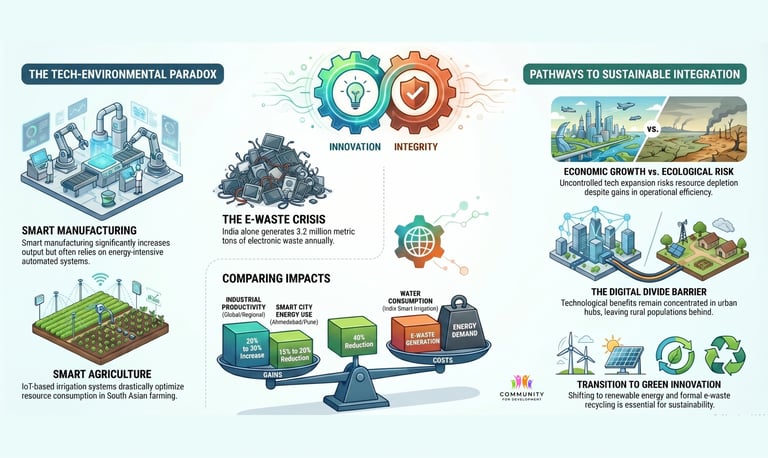
In the context of environmental sustainability, both IR 4.0 and Society 5.0 present a double-edged sword. On one hand, innovative technologies have the potential to reduce carbon emissions, optimize resource utilization, and promote sustainable practices. On the other hand, increased automation and digitalization may lead to environmental degradation, energy consumption spikes, and excessive e-waste generation.
This study investigates the intersection between technological advancements and environmental sustainability, analyzing the challenges and opportunities presented by IR 4.0 and Society 5.0. It seeks to bridge the gap between technological innovation and environmental responsibility, offering insights into how sustainable practices can be integrated into modern technological frameworks.
1.1 Statement of the Problem
The rapid adoption of advanced technologies worldwide has brought forth unprecedented environmental challenges. While IR 4.0 technologies such as smart factories, automated systems, and data-driven decision-making promise to enhance productivity and efficiency, they also increase energy consumption and resource demand. Simultaneously, Society 5.0’s emphasis on digital inclusivity and innovation raises concerns about data security, digital waste, and ecological impacts.
A significant issue lies in the uncontrolled expansion of smart technologies, which may result in depleted natural resources and rising pollution levels. Furthermore, the lack of standardized regulations for managing e-waste exacerbates environmental risks, as many developing countries struggle to keep pace with technological waste disposal practices.
This study, therefore, addresses the critical question:
How can the benefits of IR 4.0 and Society 5.0 be harnessed without compromising environmental sustainability?
1.2 Literature Review
The Fourth Industrial Revolution (IR 4.0) and Society 5.0 represent transformative shifts in how technology integrates with human lives and industries. The advent of artificial intelligence (AI), the Internet of Things (IoT), robotics, big data analytics, and smart manufacturing has significantly influenced global economies and societal structures. These advancements have the potential to enhance efficiency and productivity, yet they simultaneously pose complex environmental and socio-economic challenges. This literature review critically examines existing research and scholarly perspectives on the impact of IR 4.0 and Society 5.0 on environmental sustainability, with a particular focus on South Asia, where rapid technological adoption coexists with ecological vulnerabilities.
Theoretical Foundation of IR 4.0 and Society 5.0
The concept of IR 4.0 was first introduced at the Hannover Fair in 2011, aiming to revolutionize industrial practices through digitization and intelligent automation. According to Schwab (2017), IR 4.0 marks a paradigm shift from traditional mechanization to the seamless integration of cyber-physical systems and smart technologies. This revolution is characterized by the convergence of AI, robotics, machine learning, and data analytics, fundamentally altering the manufacturing landscape and fostering the creation of smart factories. However, despite its economic potential, critical environmental challenges have emerged, including increased energy demands, resource depletion, and electronic waste (e-waste).
In contrast, Society 5.0, conceptualized in Japan, envisions a human-centric society that utilizes advanced technologies to address social issues while promoting economic development. As highlighted by Mori and Nakamura (2019), Society 5.0 seeks to balance economic progress with environmental stewardship by embedding technological innovation within societal frameworks. Unlike IR 4.0, which primarily focuses on industrial efficiency, Society 5.0 prioritizes well-being, social inclusivity, and sustainability. Despite its visionary approach, scholars such as Yoshikawa et al. (2020) argue that the implementation of Society 5.0 has faced numerous challenges, including data privacy concerns, unequal technology distribution, and gaps in sustainable practice adoption.
Environmental Impact of IR 4.0 and Society 5.0
Numerous studies have explored the environmental implications of IR 4.0, highlighting both positive and negative impacts. According to Kagermann et al. (2016), smart manufacturing systems significantly enhance resource efficiency, reduce material waste, and minimize energy consumption through real-time monitoring and predictive maintenance. However, Berg et al. (2019) caution that the large-scale deployment of automated machinery and digital devices significantly contributes to carbon emissions and e-waste accumulation, especially in regions lacking proper waste management systems.
In their study on smart agriculture, Patel et al. (2022) found that the adoption of IoT-based irrigation systems in India resulted in a 30% reduction in water usage, thereby promoting sustainable farming practices. Nonetheless, the high initial cost and technical expertise required have limited widespread adoption, particularly among small-scale farmers. Similarly, smart energy management systems have been implemented in smart cities such as Ahmedabad and Pune, where real-time energy monitoring has reduced consumption by up to 20% (IEA, 2023). Despite these successes, the carbon footprint of data centers supporting these systems remains a significant concern, as highlighted by Hertwich and Roux (2019), who emphasize the indirect emissions associated with data storage and cloud computing.
From the perspective of Society 5.0, human-centric innovation has been positioned as a solution to environmental degradation, focusing on inclusive and sustainable development. The Japanese government’s Society 5.0 framework advocates for smart transportation, energy-efficient infrastructure, and digital healthcare systems to enhance quality of life while minimizing ecological impact (Cabinet Office of Japan, 2017). However, Kamiko and Saito (2021) highlight the practical challenges of scaling these initiatives globally, as countries with limited technological infrastructure struggle to replicate the successes achieved in Japan.
Regional Perspectives: South Asia
South Asia presents a unique context where technological aspirations intersect with environmental challenges. According to Rahman and Alam (2023), the adoption of automated textile production in Bangladesh has boosted manufacturing output but has also led to a substantial increase in energy consumption and industrial waste. The lack of regulatory oversight and inadequate recycling infrastructure exacerbate the environmental impacts of rapid automation.
India, as the leading South Asian economy, has adopted smart city initiatives that integrate AI and IoT for urban management, including waste collection, traffic control, and energy management. While these projects have enhanced urban living standards, studies by Natarajan et al. (2023) indicate that smart infrastructure significantly increases e-waste generation, creating an urgent need for recycling policies and circular economy models. Furthermore, Pakistan’s industrial automation efforts have yielded productivity improvements but are often hampered by energy shortages and pollution control deficiencies, as noted by Khan and Malik (2022).
Critiques and Gaps in Existing Literature
While the literature widely acknowledges the technological potential of IR 4.0 and Society 5.0, there remains a research gap regarding their long-term environmental impacts, particularly in developing regions like South Asia. Most studies focus on economic and operational benefits, often neglecting social and ecological consequences. Moreover, existing models primarily reflect the experiences of developed nations, with limited contextualization for South Asian socio-economic realities. There is also a lack of comprehensive data on how smart city projects and automated industries directly influence local ecosystems and biodiversity.
Additionally, although renewable energy adoption is often promoted as a mitigation strategy, the feasibility of integrating smart grids and sustainable technologies in resource-constrained environments remains underexplored. Scholars such as Patil et al. (2021) argue that policy inconsistencies and limited funding hinder the effective deployment of green technologies. Therefore, future research should address these gaps by conducting case studies and field experiments that explore the interplay between technology adoption and environmental sustainability.
Synthesis and Future Directions
This literature review underscores the dual impact of IR 4.0 and Society 5.0 on environmental sustainability, revealing both opportunities and challenges. While smart technologies hold potential for resource optimization and pollution reduction, their rapid and unregulated adoption in South Asia risks exacerbating environmental degradation and social disparities. Future research must focus on developing integrated frameworks that align technological innovation with ecological conservation, ensuring that progress towards digital transformation does not come at the cost of environmental health. Collaborative efforts among governments, industries, and academic institutions are essential to build resilient and sustainable systems that accommodate technological evolution without sacrificing ecological integrity.
1.3 Significance of the Study
The significance of this study lies in its comprehensive examination of the Fourth Industrial Revolution (IR 4.0) and Society 5.0, focusing on their profound impacts on environmental sustainability, particularly in the South Asian context. As technological advancements continue to redefine industrial practices and societal structures worldwide, it becomes increasingly crucial to understand how these transformations influence the natural environment and socio-economic landscapes. This study not only addresses a critical gap in existing literature but also offers practical insights for policymakers, industry leaders, environmentalists, and academic researchers who are striving to balance technological innovation with sustainable development.
Academic Significance
From an academic perspective, this study contributes significantly to the growing body of knowledge on IR 4.0 and Society 5.0 by offering an in-depth analysis of their environmental and socio-economic impacts. While a substantial volume of literature already exists on technological advancements and digital transformation, most studies predominantly focus on developed economies, such as Germany, Japan, and South Korea, where technological infrastructure is advanced and sustainability initiatives are well-established. In contrast, there is a noticeable research gap concerning the developing regions of South Asia, where rapid industrialization and digital transformation coexist with persistent environmental and infrastructural challenges.
This study addresses this gap by investigating how smart technologies and automation are being adopted in South Asian countries like India, Bangladesh, Pakistan, Nepal, and Sri Lanka, and how these technologies impact environmental sustainability. By incorporating case studies and comparative analyses, the study provides context-specific insights that are crucial for understanding the nuanced challenges and opportunities unique to the region. Additionally, it enriches academic discourse by critically evaluating the theoretical frameworks of IR 4.0 and Society 5.0, identifying strengths and limitations in their practical applications, and suggesting contextual adaptations suitable for developing economies.
Moreover, this study’s findings add value to interdisciplinary research, combining elements of environmental science, economics, technology management, and policy studies. This approach not only broadens the scope of academic inquiry but also encourages collaborative research efforts aimed at developing sustainable solutions that leverage advanced technologies without compromising ecological integrity.
Practical Significance
The practical significance of this study lies in its potential to inform and guide policymakers, industry practitioners, and environmental planners. As South Asian countries continue to pursue technological modernization, it is essential to address the environmental consequences associated with industrial automation, smart city projects, and digital infrastructure expansion. Policymakers can benefit from this study by gaining insights into successful models of sustainable technological integration from both developed and developing countries, enabling them to make informed decisions about adopting smart technologies while minimizing environmental harm.
For industry leaders, the study provides practical guidance on integrating eco-friendly practices into smart manufacturing and industrial automation. It highlights the importance of energy-efficient technologies and responsible e-waste management, helping industries reduce their carbon footprint and align with global sustainability standards. This is particularly relevant in sectors like textile and garment manufacturing in Bangladesh, where the adoption of automated machinery has significantly increased energy consumption and waste generation. By presenting best practices and real-world case studies, the study empowers industries to make strategic investments in green technologies that support both productivity and environmental stewardship.
Furthermore, urban planners and smart city developers can leverage the findings to create sustainable urban environments by incorporating renewable energy systems, smart waste management, and efficient resource utilization. Given the rapid growth of smart cities in India and Sri Lanka, the study’s recommendations can help enhance urban resilience while addressing environmental challenges associated with population density and industrial emissions.
Social and Environmental Significance
The study’s social significance is grounded in its emphasis on bridging the digital divide and promoting social inclusivity. In many South Asian countries, technological advancements disproportionately benefit urban populations, leaving rural and marginalized communities behind. This divide undermines the essence of Society 5.0, which envisions a human-centric society that harmonizes economic growth with social well-being. By addressing the socio-economic disparities associated with smart technology adoption, this study advocates for inclusive policies that ensure equitable access to digital infrastructure and technological benefits.
On an environmental level, the study underscores the urgent need to address the ecological consequences of technological proliferation. The rise of automated industries and digital ecosystems has led to increased energy demands, waste generation, and environmental pollution, particularly in countries that lack adequate regulatory frameworks. This study highlights how renewable energy integration and sustainable waste management can mitigate the negative impacts of IR 4.0, fostering a balanced approach to technological innovation.
By presenting evidence-based recommendations, the study serves as a call to action for governments and private sectors to prioritize environmental conservation while advancing towards digital transformation. Addressing the intersections of technology, society, and the environment is essential for achieving the United Nations Sustainable Development Goals (SDGs), particularly those related to climate action, responsible consumption, and sustainable cities.
Significance for Future Research and Policy Development
The study also lays the foundation for future research aimed at developing holistic frameworks that integrate technological advancements with environmental sustainability goals. As technology continues to evolve, it is crucial to anticipate future challenges and develop adaptive strategies that can mitigate environmental impacts while leveraging innovation for social good. Researchers can build on this study by conducting longitudinal analyses to track the long-term effects of smart technology adoption on both human well-being and ecological health.
From a policy development perspective, the study’s insights can guide the formulation of regulatory frameworks that encourage green innovation and responsible automation. Governments must balance economic modernization with ecological protection, crafting policies that promote circular economies and sustainable resource utilization. Additionally, the study advocates for capacity-building initiatives to enhance digital literacy and environmental awareness among communities, thereby fostering responsible consumption practices and active participation in sustainable development.
Concluding Reflection
In essence, the significance of this study transcends mere academic analysis, as it addresses the real-world challenges and opportunities associated with IR 4.0 and Society 5.0. By examining both the technological potentials and environmental risks, this research contributes to the broader discourse on sustainable development in South Asia. It serves as a guiding framework for stakeholders across various sectors, including policy formulation, industrial planning, environmental management, and community engagement. The study ultimately emphasizes the need for balanced and inclusive approaches to technological adoption, ensuring that modernization does not come at the cost of environmental integrity and social equity.
1.4 Limitations of the Study
The primary limitations of this study include:
Data Availability: Limited access to up-to-date data and peer-reviewed literature on emerging technologies.
Geographical Scope: While this study covers both global and regional contexts, the analysis may not fully capture local variations and country-specific challenges.
Subjectivity in Interpretation: Differences in the interpretation of sustainability concepts may affect the generalizability of the findings.
Technological Uncertainty: Rapid changes in technological advancements make it challenging to predict long-term environmental impacts accurately.
4th Industrial Revolution and Society 5.0
Part 01: Introduction
©2026 Community For Development. All Rights Reserved.
Reframe Your Inbox
Subscribe to Our Newsletter and Never Miss an Update.
We care about your data in our privacy policy.
About Us
Connecting development practitioners and community changemakers with curated opportunities, tools, and resources from across the humanitarian and development sector.
"Community For Development" is a sector-focused knowledge platform built on a simple belief, "The people doing the hardest work in development shouldn't have to hunt for the tools to do it better".
We curate opportunities; jobs, fellowships, grants, and training; alongside sector resources, digital tools, and practical guides, and keep the core of it free and accessible. Our growing e-book archive, sector databases, and open blog are available to anyone; whether you're based in a ministry in Nairobi, a local NGO in Cox's Bazar, or a policy institute in Brussels.
To sustain that commitment to open access, we also offer premium operational tools, advanced guides, and carefully selected affiliate resources; products and platforms we've assessed for their genuine value to development practitioners. Every premium resource you explore helps keep our core knowledge base free for the organisations and professionals who need it most.
This is how we stay independent, stay relevant, and stay useful.